
French Press is a manual immersion brewing method known for its straightforward preparation and full-bodied cup profile.
Instead of passing water through a bed of coffee grounds, as pour-over methods do, a French Press allows the coffee and water to steep together. A mesh plunger is then pressed down to separate most of the grounds from the brewed coffee.
Because the metal filter allows more coffee oils and fine particles to remain in the cup than a paper filter, French Press coffee often has a heavier body and more pronounced texture. The method does not require a controlled pouring technique, although grind size, coffee-to-water ratio, water temperature and steeping time still influence the result.
A French Press may suit you if you enjoy a richer, more textured cup and prefer a brewing routine that involves minimal equipment. It may be less suitable if you prefer the cleaner, lighter profile typically associated with paper-filtered coffee.
Understanding French Press
What Is a French Press?
A French Press is an immersion brewer in which coarsely ground coffee steeps directly in hot water. After brewing, a plunger fitted with a metal mesh filter is pressed down to hold most of the grounds at the bottom of the carafe.
Unlike paper-filtered methods, the mesh filter allows more coffee oils and very fine particles to remain in the cup. This contributes to the characteristic body and texture of French Press coffee, although a small amount of sediment may also be present.
The brewer itself is simple, but consistent results still depend on using an appropriate grind size, coffee-to-water ratio, water temperature and steeping time.
The French Press Brewing Experience
French Press brewing has a relatively hands-off workflow. After the coffee and water are combined, the brew is left to steep before the plunger is lowered and the coffee is served.
There is no need to maintain a precise pouring pattern, but consistency still depends on the grind size, coffee-to-water ratio, water temperature and steeping time. Pouring the coffee soon after plunging also helps limit continued extraction inside the carafe.
This makes the method well suited to people who prefer a calm, repeatable routine or want to prepare several servings in a single brew.
How to Choose a French Press Setup
Choosing a French Press setup depends on the cup profile you enjoy, how much coffee you usually brew, the space available, and how involved you want the preparation and cleanup to be.
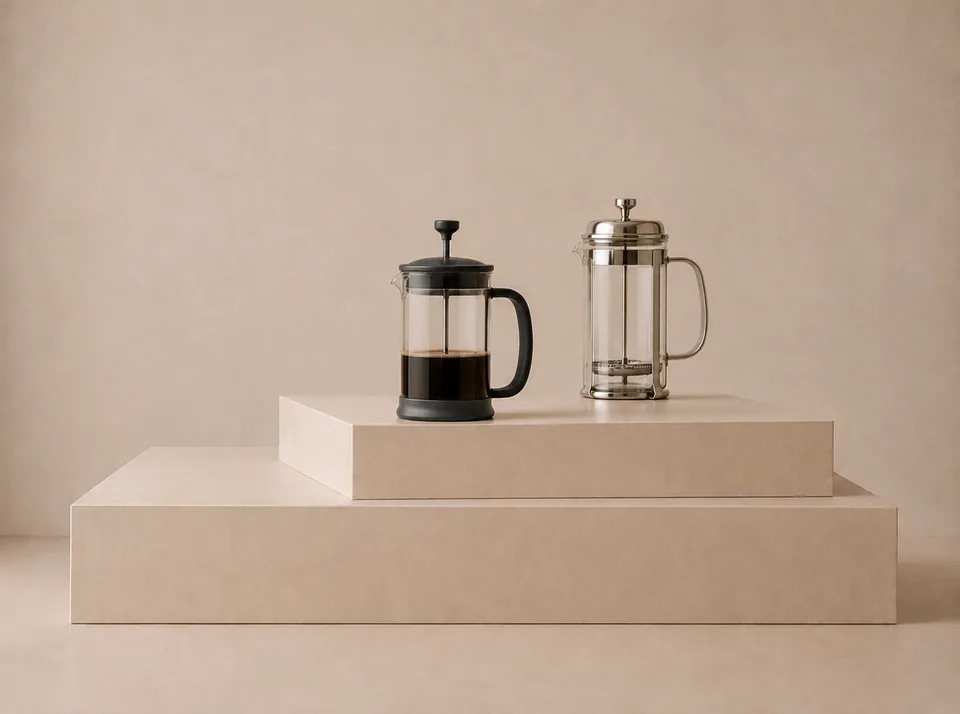
Coffee Body and Texture
French Press coffee typically has a fuller body and more pronounced texture than paper-filtered coffee. The metal mesh filter allows more oils and fine particles to remain in the cup, which can also produce a small amount of sediment.
Consider whether you enjoy:
- A heavier, more textured cup
- Some natural sediment
- Less clarity than paper-filtered methods
Simplicity and Routine
French Press brewing does not require a controlled pouring pattern. After the coffee and water are combined, the brew is left to steep before the plunger is lowered.
The process is straightforward to learn, but repeatable results still depend on grind size, coffee-to-water ratio, water temperature, and steeping time.
Consider whether you prefer a mostly hands-off brewing routine and are comfortable cleaning the carafe, plunger, and mesh filter after use.
Serving Size
French Press brewers are available in sizes suited to a single mug or several servings. Choose according to the amount of coffee you normally prepare rather than relying only on the manufacturer’s cup count, which may refer to smaller servings than your usual cup.
Check the stated capacity in milliliters or fluid ounces and consider whether you usually brew for yourself or share coffee with others. A size that matches your typical batch will be easier to use consistently.
Space and Equipment
A French Press has a relatively small footprint, but the complete setup may also include a kettle, grinder, scale, and other measuring tools. Consider where these items will be stored and whether the brewing area provides convenient access for preparation and cleanup.
Consider:
- Countertop and storage space
- Placement for the kettle and grinder
- A scale or other measuring tools
- A practical way to dispose of wet coffee grounds
Keeping the setup compact and easy to clean makes it more practical for regular use.
Before Choosing a French Press
Before choosing a French Press, it helps to understand how its immersion-based workflow and cup profile differ from other brewing methods.
French Press generally produces a fuller-bodied, more textured cup with a relatively hands-off steeping stage. V60 and Chemex emphasize paper-filtered clarity and pouring control, while a drip coffee maker offers a more automated routine. The best fit depends on the cup profile, level of involvement, serving size, and workflow you prefer.
V60 vs French Press
French Press and V60 use different extraction and filtration methods. A French Press immerses the coffee grounds in water for the full brewing period, then uses a metal mesh plunger to hold most of the grounds below the surface. This typically produces a fuller body, more pronounced texture, and some fine sediment.
A V60 is a pour-over brewer that uses a paper filter. Water passes through the coffee bed as it is poured, producing a cleaner, lighter-bodied cup with greater clarity. The method also places more emphasis on grind size, pouring technique, and flow rate.
Choose based on the experience you prefer:
- Choose French Press for a fuller, more textured cup and a mostly hands-off steeping stage.
- Choose V60 for greater clarity and a more technique-driven brewing process.
Chemex vs French Press
French Press and Chemex differ in both brewing workflow and filtration. French Press uses full immersion and a metal mesh filter, creating a heavier body and more pronounced texture.
Chemex uses a pour-over method and typically relies on a thicker paper filter, which removes more oils and fine particles from the brewed coffee. The result is usually a cleaner, lighter-bodied cup with greater clarity, although the process requires controlled pouring and more active attention.
Consider your preferences:
- Choose French Press for fuller body and straightforward immersion brewing.
- Choose Chemex for a cleaner cup and a slower, pour-over-focused routine.
As an Amazon Associate I earn from qualifying purchases.
For Classic Glass French Press
Bodum Chambord 34 oz
- Borosilicate glass carafe
- 34 oz capacity
- Stainless-steel plunger
For Heat Retention & Durability
Secura 34 oz French Press
- Double-wall stainless steel
- Keeps coffee hotter
- Durable metal build
For No-Plastic Contact
Veken 34 oz French Press
- No plastic coffee contact
- 4-layer filtration
- 34 oz capacity
For Smaller Batches
QUQIYSO 21 oz French Press
- 21 oz capacity
- 4-layer filtration
- Borosilicate glass carafe
Featured French Press Guides
French Press brewing is straightforward, but the brewer, grind, ratio, steeping time, and cleanup routine all influence the final cup.
The guides in this section cover choosing a suitable French Press, understanding the immersion brewing process, and building a more consistent preparation routine.
How to Choose a French Press
Choosing a French Press involves more than selecting a carafe size. Capacity, construction material, filter design, heat retention, and cleanup can all affect how practical the brewer is for regular use.
This guide explains the main factors to consider when matching a French Press to your preferred cup profile, serving needs, available space, and daily routine.
French Press Brewing Guide
French Press uses full immersion, allowing the coffee grounds and water to steep together before a mesh plunger holds most of the grounds below the brewed coffee.
This guide covers grind size, coffee-to-water ratio, water temperature, steeping time, plunging, serving, and cleanup to help you develop a repeatable French Press routine.
French Press Comparisons
Comparing different French Press designs and alternative brewing methods can help you decide whether their durability, preparation style, filtration, and cup profile match your preferences.
Glass vs Stainless Steel French Press
Glass and stainless steel French Press brewers use the same immersion process, but they differ in durability, heat retention, weight, and everyday handling.
A glass carafe lets you see the brewing process, but it is more vulnerable to breakage and generally loses heat faster. Stainless steel models are more durable, and double-walled versions usually retain heat for longer, although they are opaque and may be heavier.
Choose glass if visibility and a lighter visual design matter most. Choose stainless steel if durability and heat retention are higher priorities.
French Press vs AeroPress
French Press and AeroPress can both use immersion, but their filtration, pressure, and typical serving sizes create different brewing routines and cup profiles.
A French Press relies on a metal mesh plunger and is commonly used for one or several servings, producing a fuller-bodied cup with more oils and fine particles. An AeroPress uses manual pressure to push brewed coffee through a paper or metal filter and is generally better suited to smaller batches, shorter brew times, and recipe experimentation.
Choose according to the serving size, portability, filtration style, and level of brewing flexibility you prefer.
FAQ
Yes. A French Press is approachable for beginners because it does not require a controlled pouring pattern or a highly technical brewing workflow. You still need to pay attention to grind size, coffee-to-water ratio, water temperature, and steeping time, but the overall process is straightforward to learn and repeat.
Our French Press Brewing Guide explains the complete process step by step, from measuring the coffee and water to plunging and serving.
A French Press uses full immersion, meaning the coffee grounds remain in contact with the water for most of the brewing time. After steeping, a metal mesh plunger holds most of the grounds at the bottom of the carafe.
Unlike paper filters, the mesh allows more coffee oils and fine particles to remain in the brewed coffee. This usually creates a fuller body, more pronounced texture, and a small amount of sediment.
A French Press can work well for everyday use if you enjoy a fuller-bodied, more textured cup and prefer a mostly hands-off steeping stage. It can prepare one or several servings with relatively little equipment.
Everyday practicality also depends on whether you are comfortable cleaning the carafe, plunger, mesh filter, and wet coffee grounds after each brew.
No. At minimum, you need a French Press, ground coffee, and hot water. A burr grinder, scale, kettle, and timer are not mandatory, but they make it easier to control grind size, coffee-to-water ratio, water temperature, and steeping time.
A medium-coarse to coarse grind is a common starting point, although the most suitable setting depends on the brewer, coffee, and recipe.