
Coffee grinders play a central role in home coffee preparation because grind size and particle consistency directly affect extraction. A grinder that produces an even grind can help create a more balanced cup, while its adjustment range determines which brewing methods it can support.
Whether you make espresso, pour-over coffee, drip coffee or another style of coffee, choosing a grinder that suits your routine makes it easier to repeat your preferred settings and achieve more consistent results.
The right grinder depends on how you brew, how much control you want, how often you prepare coffee and whether you prefer the speed of an electric model or the simplicity of a manual one.
Explore Coffee Grinder Types
Coffee grinders can be grouped by how they are powered and by the brewing methods they are designed to support. These categories can overlap—for example, an electric or manual grinder may also be designed specifically for espresso or filter coffee.
Electric Coffee Grinders
Electric coffee grinders use a motor to grind beans quickly and with less physical effort. Models vary in grind adjustment, consistency, capacity and noise level, so the right option depends on the brewing methods you use and how much control you need.
They are especially practical for frequent brewing, larger batches and coffee routines where speed and repeatability matter.
Manual Coffee Grinders
Manual coffee grinders use a hand crank and are typically compact, quiet and easy to store. Many burr models offer precise adjustment and good grind consistency, although grinding requires more time and physical effort than with an electric model.
They are well suited to smaller batches, travel and coffee routines where portability and hands-on control matter more than speed.
Espresso Grinders
Espresso grinders are designed to produce a fine, consistent grind and allow small, repeatable adjustments. Because espresso is sensitive to minor changes in particle size and dose, a suitable grinder makes it easier to control shot time and extraction.
They are best suited to espresso-focused routines where precise dialing-in and repeatable dosing are important.
Grinders for Filter Coffee
Grinders for filter coffee are designed to perform well across the medium-to-coarse settings commonly used for V60, Chemex, drip coffee and similar brewing methods. Good particle uniformity helps water move through the coffee bed more evenly and can reduce muddiness or uneven extraction.
This type is suitable when pour-over or batch-brewed coffee makes up most of your routine and you do not need the very fine, incremental adjustment required for espresso.
How to Choose a Coffee Grinder
Choosing a coffee grinder depends on your brewing method, daily routine, and how much control you want over grind size and preparation.
A grinder is more than a supporting tool: it directly affects grind consistency, adjustment precision, and how easily you can repeat your preferred results. Understanding these needs will help you choose a grinder that suits your setup.
Brewing Method
The brewing method you use is one of the most important factors when choosing a grinder.
Different brewing methods require different grind sizes, and some demand a narrower and more precise adjustment range.
Consider:
- Espresso requires fine, incremental adjustments and consistent grinding.
- Pour-over methods benefit from uniform particles and enough range to adjust for different brewers and recipes.
- Drip coffee typically uses medium grind settings and benefits from consistent grinding across larger batches.
Choosing a grinder that supports your main brewing method will make it easier to dial in and repeat your preferred results.
Grind Adjustment and Control
The ability to adjust grind size gives you more flexibility when preparing coffee.
Some grinders use clearly defined steps, while others allow smaller and more precise changes. Fine adjustment is especially important for espresso, whereas a straightforward stepped system may provide sufficient control for filter coffee.
Consider how often you switch between brewing methods and how much time you want to spend dialing in each setting.
Electric vs Manual
Electric and manual grinders offer different trade-offs.
Electric grinders reduce physical effort and are generally faster, making them practical for frequent use, multiple cups, or larger doses.
Manual grinders are usually compact, quiet, and portable, but they require more time and physical effort.
Choose electric if speed, convenience, and frequent use are priorities. Choose manual if portability, low noise, and hands-on control matter more.
Daily Coffee Routine
Your coffee habits should guide your grinder choice.
Consider:
- How often you prepare coffee
- How many cups you make at a time
- Which brewing methods you use
- Whether you frequently change grind settings
- How much time and effort you want to spend grinding
A grinder should support your routine rather than make it more complicated.
Before Choosing a Coffee Grinder
Before choosing a coffee grinder, compare the trade-offs between integrated and separate setups, espresso- and filter-focused models, and manual and electric operation.
The right choice depends on your brewing method, available space, preferred level of control, and how much flexibility you want from your coffee setup.
Built-in Grinder vs Separate Grinder
Built-in grinders and separate grinders offer different balances of convenience, flexibility, and long-term upgradeability.
A built-in grinder is integrated into a coffee machine, reducing the number of separate appliances and simplifying the preparation process. This can be useful when counter space is limited or when you prefer an all-in-one setup. However, the available grind settings, burr system, and upgrade options are limited by the machine’s design.
A separate grinder allows you to choose your grinder and brewing equipment independently. It generally provides more flexibility when matching grind quality to your brewing method and makes it easier to repair or upgrade one component without replacing the entire setup.
Choose a built-in grinder if compactness and convenience are priorities. Choose a separate grinder if grind control, equipment flexibility, and long-term upgradeability matter more.
Espresso Grinder vs Filter Coffee Grinder
Espresso and filter coffee place different demands on a grinder.
Espresso requires very fine grinding and small, repeatable adjustments because minor changes in grind size can significantly affect shot time and extraction. An espresso-focused grinder should therefore provide precise adjustment and consistent performance at fine settings.
Filter coffee generally uses medium-to-coarse grind settings. A filter-focused grinder should produce uniform particles and limit excessive fines across the settings used for V60, Chemex, drip coffee, and similar brewing methods.
Choose an espresso-focused grinder if espresso is your main priority. Choose a filter-focused grinder if you mainly prepare pour-over or batch-brewed coffee. If you regularly use both brewing styles, look for a grinder specifically designed to perform well across both ranges.
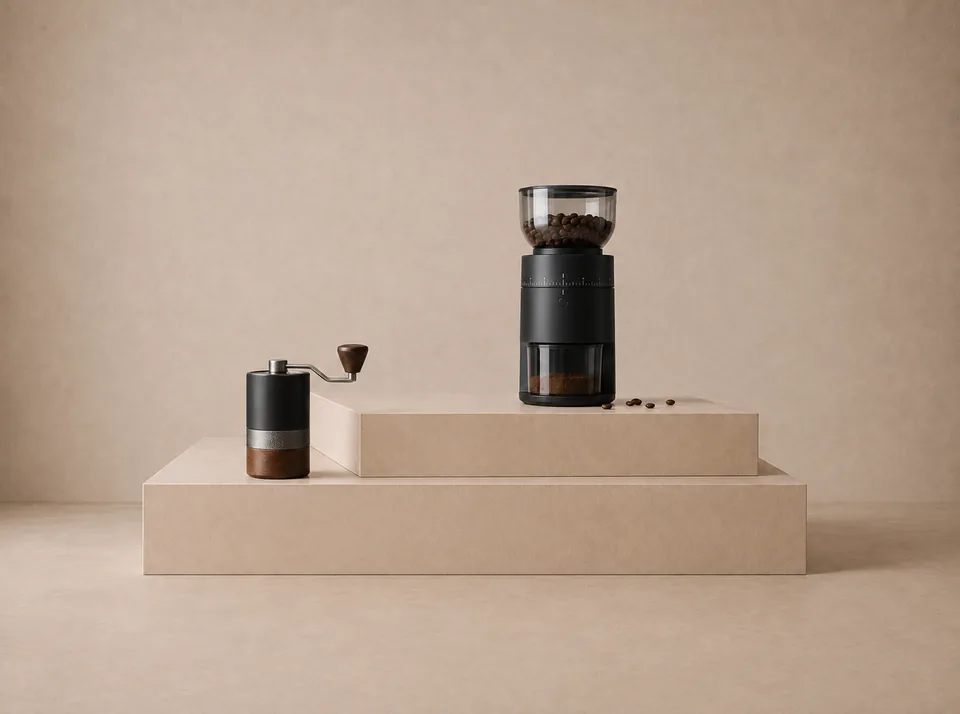
Manual vs Electric Coffee Grinders
Manual and electric grinders differ mainly in speed, physical effort, capacity, noise, and portability.
Manual grinders are typically compact, quiet, and easy to transport. Well-designed models can provide good grind consistency, but they require physical effort and are generally better suited to smaller doses.
Electric grinders are faster and easier to use for frequent brewing, multiple cups, or larger batches. They require more counter space and produce more noise, while their adjustment precision and grind consistency vary by model.
Choose a manual grinder if portability, quiet operation, and hands-on preparation are priorities. Choose an electric grinder if speed, capacity, and daily convenience matter more.
As an Amazon Associate I earn from qualifying purchases.
For Lower-Cost Everyday Grinding
Hamilton Beach Fresh Grind
- Simple blade grinding
- Removable grinding chamber
- Easy cleanup
For Entry-Level Burr Grinding
Cuisinart DBM-8P1
- 18 grind settings
- Burr grinding
- Large bean hopper
For More Grind Control
OXO Brew Conical Burr Grinder
- 43 grind settings
- Conical burr grinder
- 12 oz bean hopper
For Consistent Home Brewing
Baratza Encore
- Consistent burr grinding
- 40 grind settings
- Beginner-friendly controls
Featured Grinder Guides
Understanding how coffee grinders work can help you achieve more consistent results and choose equipment that suits your brewing routine. These guides explain why grinding matters, how grind size changes across brewing methods, and which grinder features deserve attention.
How to Choose a Coffee Grinder
A guide to understanding why grinding matters, how grind size and consistency affect extraction, and what to consider when choosing a grinder for your brewing method and daily routine.
Coffee Grind Size Guide for Different Brewing Methods
A guide to understanding how grind size changes across espresso, pour-over, drip, and immersion brewing methods.
It explains how particle size influences water flow, extraction, and brewing time, helping you identify a practical starting point for each method.
Coffee Grinder Features Explained
A guide to common coffee grinder features, including burr type and size, adjustment systems, dosing options, grind range, retention, and hopper capacity.
It explains how these features affect grind control, workflow, maintenance, and daily use, helping you decide which ones matter for your coffee routine.
Grinder Comparisons
Comparing grinder designs can help you understand how each option affects grind consistency, workflow, flexibility, and cost. The right choice depends on your brewing methods, how often you change coffees or grind settings, and how much control you want over the grinding process.
Burr Grinder vs Blade Grinder
Burr and blade grinders use fundamentally different grinding mechanisms. A burr grinder crushes coffee beans between two abrasive surfaces set at a controlled distance, while a blade grinder chops them with a rapidly rotating blade.
Burr grinders generally produce a more uniform particle distribution and offer repeatable grind adjustment, making them the stronger choice for espresso, pour-over, drip coffee, and most other brewing methods. Blade grinders are usually more affordable and compact, but grind size is controlled mainly by grinding time, which often produces an uneven mixture of fine and coarse particles.
Choose a burr grinder when consistency and grind control matter. A blade grinder may suit a very limited budget or occasional basic use, but it provides considerably less precision.
Single-Dose vs Hopper Grinders
Single-dose and hopper grinders are designed around different coffee workflows.
A single-dose grinder is intended for weighing each portion of beans before grinding. This makes it easier to switch between coffees and is often combined with a low-retention design, although the actual amount of coffee retained inside the grinder varies by model.
A hopper grinder stores a larger quantity of beans and is convenient for repeated use with the same coffee, especially when speed and routine dosing matter.
Choose single-dose if you frequently change beans, prefer to weigh each dose, or want to reduce coffee carryover between uses. Choose a hopper grinder if you usually use the same beans and prefer a faster daily workflow.
FAQ
A coffee grinder controls particle size and consistency, which influence how quickly and evenly water extracts flavor from the coffee. Grinding beans shortly before brewing also helps preserve their aroma compared with using coffee that was ground well in advance. A grinder with repeatable settings makes it easier to adjust recipes and achieve more consistent results across different brewing methods.
No. A separate grinder is not necessary if your coffee machine has a suitable built-in grinder or if you are comfortable using pre-ground coffee. However, a separate grinder usually provides more control over grind size, makes it easier to switch between brewing methods, and can be upgraded independently. The better choice depends on your brewing method, available space, and how much flexibility you want from your setup.
Yes, a manual grinder can work well for everyday use, especially for one or two cups, smaller batches, quiet kitchens, or portable setups. The trade-off is the additional time and physical effort required, particularly when grinding for espresso or preparing larger doses. Capacity, adjustment range, burr performance, and handle comfort are important considerations for daily use.
Choose an electric grinder if you value speed, larger capacity, and minimal physical effort, especially when you brew frequently or prepare several cups at a time. Choose a manual grinder if you prioritize portability, quiet operation, compact storage, and a more hands-on process. Our How to Choose a Coffee Grinder guide explains how your brewing method, required adjustment range, and daily routine should shape the decision.